Interoperability is the foundation of digital sovereignty; it’s the key ingredient in making sure the end-user stays in control, rather than the vendor.
In reality, of course, most vendors want to be the one with the power. Vendors aim to lock their users in, and to build a proprietary walled garden as quickly as possible. This is why WhatsApp users can only message other WhatsApp users. Likewise, it’s Teams to Teams, Slack to Slack, Wire to Wire, Signal to Signal, Zoom to Zoom.
These walled gardens have become regarded as normal. But it’s not how the original web was designed, and it’s not how previous communications solutions – such as telephones and email – operate. All three have interoperability as their foundation.
The importance of interoperability
Interoperability is the ability of different systems, platforms, and organisations to communicate and work together seamlessly, regardless of who built the underlying technology. Its importance lies in the fact that without it, digital infrastructure fragments into isolated silos - agencies can't coordinate, allies can't communicate securely across borders, and organisations become permanently dependent on a specific vendor.
For governments in particular, interoperability is a prerequisite for genuine digital sovereignty: it means you can switch suppliers without losing your data or your network, federate securely with partners without routing traffic through a third-party cloud, and build on standards that outlast any single commercial relationship. In short, interoperability is what transforms communications infrastructure from a vendor dependency into a genuine strategic asset that the government, not the market, controls.
Interoperability is not technically difficult. The reason traditional vendors don't offer it is not that they can't - it's that they don't want to. Interoperability removes the most powerful commercial lever a software company has: the cost of exit.
Whereas if your customers can leave easily, most importantly, they can genuinely trust you. Second, as the vendor, you have to keep on innovating and delivering to continue to earn their business.
Two parts of interoperability
When it comes to communications infrastructure, interoperability needs to operate on two distinct levels, and governments evaluating their sovereignty posture should be clear-eyed about both.
The first is server-side interoperability. This revolves around the ability to pick and mix your backend set-up; being able to switch easily between various vendors’ products and services, as well as the option to bring in in-house developed FOSS components, as needs evolve.
Being vendor-locked is a slow-motion disaster; your data, identity management, chat history, and operational logic all become entangled in one non-interoperable backend.
When the moment comes to migrate - a result of geopolitical risk, cost, policy or simply because a better option has emerged - you discover that "migration" really means a big “rip and replace” with all the risk, cost, and distraction that creates.
The second is open standard federation. This is about the ability for separate deployments - potentially from entirely different vendors, or bespoke-built in-house systems - to connect and exchange messages with one another. Without an open standard underpinning this, federation simply doesn't happen: siloed systems stay siloed, and cross-agency or cross-border collaboration requires either everyone standardising on the same vendor, or clunky, insecure workarounds.
Open standard federation alone isn't the same thing as sovereignty. A government could federate beautifully across agencies while every one of those agencies remains individually locked into a single vendor's backend.
Real digital sovereignty requires both: open federation between deployments, and the freedom to choose, combine, or replace the server-side stack. A full Matrix stack delivers on both: an open standard for federation, and a stack with no server-side lock-in.
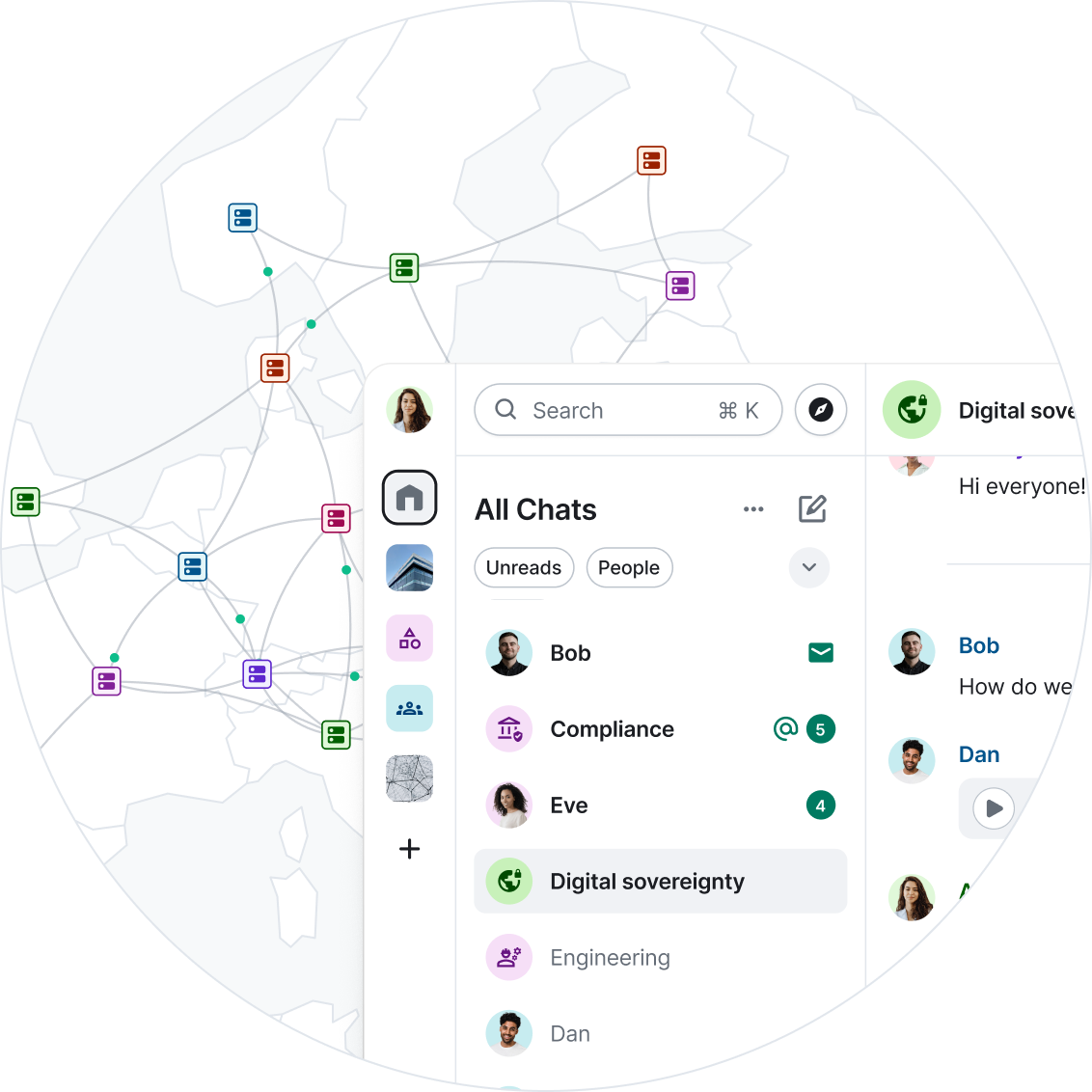
Does your country own its ability to communicate?
Download the studyEuropean Big Tech solves nothing
With geopolitics evolving rapidly, governments - particularly those in Europe - are moving quickly to ensure they are in control of their communications technology. There has been considerable momentum to ‘buy European,’ but the focus should be on avoiding the same vendor-lock business model.
If a government replaces Microsoft Teams with a similarly proprietary European alternative, all it’s done is change the nationality of its dependency. The vendor still controls the protocol, the data format, and the roadmap; the government still cannot federate freely with other agencies or allies, cannot migrate without rebuilding its communications network from scratch, and cannot independently audit or extend the platform without the vendor's permission.
As Germany's Federal Minister for Digital, Karsten Wildberger, put it at the Summit on European Digital Sovereignty: "Digital sovereignty means having choices, so no single technology and provider becomes a dependency that can be used against our interests."
Recent years have demonstrated exactly how fragile centralised communication systems can be; through technical failures, geopolitical pressure and decisions made in foreign jurisdictions without warning. The evidence is detailed in our study. The pattern is structural.
Matrix is built for interoperability
Element operates on the Matrix open standard. Matrix-based components are interchangeable, whether that’s various parts on the server-side, or mix and matching between backends and frontends.
There’s a whole range of FOSS components. Element's own FOSS components are publicly available to support the community and smaller deployments. These components are a large part of Element being recognised as a Digital Public Good.
There’s also an ever-increasing range of Matrix-based productised offerings. Ours are primarily Element Server Suite Pro and Element Pro, as well as related SLAs and technical support, and are designed for government use.
Organisations can switch vendors, bring infrastructure in-house, or commission services from any of the 40+ vendors in the Matrix ecosystem without losing continuity, history or connectivity.
Open standard federation
The Matrix open standard also enables federation between separate organisations. A recent example to go live is from Sweden where two of Sweden's major public sector agencies, Försäkringskassan (the Swedish Social Insurance Agency) and Trafikverket (the Swedish Transport Administration), successfully federated their communications systems; with Försäkringskassan using Element (branded as SAFOS Chatt) and Trafikverket using Rocket.Chat.
Totally different Matrix-based systems, from different vendors or developed in-house, provide the perfect foundation for communications across an entire ecosystem (such as Germany’s healthcare system), cross-border collaboration or mission partnership environments.

Disruption with purpose
We're proud to be a disruptive force. Matrix, created by the team that founded Element, was disruptive by design. It was conceived as the missing communications layer of the internet, which is the genesis of its decentralised architecture which - alongside the interoperability that comes from being an open standard - is what makes genuine digital sovereignty possible.
For Matrix to deliver on that promise, it has to operate independently of any single commercial interest. It is overseen by The Matrix.org Foundation, a non-profit supported by a broad coalition of end-user organisations and vendors; a governance model that ensures the standard remains a public good, not a product.
Element has backed that principle with action, contributing substantial amounts of open source software to the project. That commitment reflects something we believe deeply; that governments and citizens should remain in control of their own communications infrastructure. It's a long-term investment in an ecosystem we want to see thrive.
The growth of Matrix - across government deployments, allied nations, and an expanding community of vendors and implementers - is genuinely exciting to witness. A healthy, competitive Matrix ecosystem is exactly what the standard was designed to produce. It drives innovation, raises the bar for everyone building on Matrix, and gives governments the freedom to choose suppliers on merit rather than out of necessity.
The disruption is spreading. Governments are addressing the way they procure open source software responsibly, recognising that the long term value of standards like Matrix depend on sustaining the projects that underpin them. That points to a future where open, interoperable infrastructure is the norm; to the benefit of governments and the citizens they serve.